
Upload File
Upload File is the fastest way to turn a ready-made HTML email into sendable content in Dengage. If your design team, agency, or another platform has already produced the HTML, you don't need to rebuild anything. Package the HTML and its images as a ZIP file, upload it, and Dengage generates the email content in seconds.
Use Upload File when:
- You receive finished HTML emails from a design agency or your designers.
- Your team codes emails in its own tools and only needs Dengage for sending, personalization, and reporting.
If you prefer to build the email inside Dengage instead, see the Rich Text Editor, Email Builder, or Code Editor guides.
Before You Start: Prepare Your ZIP File
The upload accepts a single .ZIP file of up to 10 MB. What matters most is the folder structure inside the ZIP. An incorrect structure is the most common reason an upload fails, so it is worth getting right the first time.
Single-Language Structure
The ZIP must contain one folder named exactly after the ZIP file. Inside that folder, place one HTML file and, if your design uses images, an optional images subfolder containing the image files (.png and .jpeg only):
newsletter.zip
└── newsletter/
    ├── newsletter.html
    └── images/          (optional)
        ├── banner.png
        └── product.jpeg
Multi-Language Structure
To create one email with several language versions in a single upload, add one subfolder per language inside the top-level folder. Each language folder must be named with a supported language code written in uppercase (e.g. EN, TR, DE) and must contain its own HTML file and optional images subfolder:
campaign.zip
└── campaign/
    ├── EN/
    │   ├── campaign.html
    │   └── images/
    ├── TR/
    │   ├── campaign.html
    │   └── images/
    └── DE/
        ├── campaign.html
└── images/Only supported language codes are accepted as folder names in multi-language ZIPs. A folder named ENGLISH or en-US will not be recognized; use EN.
Naming Rules and Limits
| Requirement | Details |
|---|---|
| File format | .ZIP only |
| Maximum size | 10 MB per ZIP |
| Folder name | Must be identical to the ZIP file name |
| HTML files | Exactly one HTML file per folder (per language folder in multi-language ZIPs) |
| Images | Optional images subfolder; .png and .jpeg files only |
| Characters to avoid | Special characters such as quotation marks ( " ), apostrophes ( ' ), underscores ( _ ), and Turkish characters (ç, ğ, ı, ö, ş, ü) in folder and file names. Stick to plain letters, numbers, and hyphens. |
| Language folders | Uppercase supported language codes only |
Not sure about the structure? Download a working example directly from the upload screen. The Single language sample and Multi language sample buttons sit right above the upload area.
Create an Email with Upload File
- Go to Content > Marketing > Email and click + New in the upper-right corner.
- In the Select a Type dialog, choose Upload File. (You can also preview an example ZIP from the See sample file link on the card.)
Upload file
Step 1: General
- Enter a Content Name. This is the internal name you will search for later; it is not shown to recipients.
- Pick a Folder to keep your content organized. The default is Email Content; click Change Folder to select another folder or create a new one.
- Click Next to open the Content step. You can return and rename or re-folder the content at any time with the edit (pencil) icon on the General card.
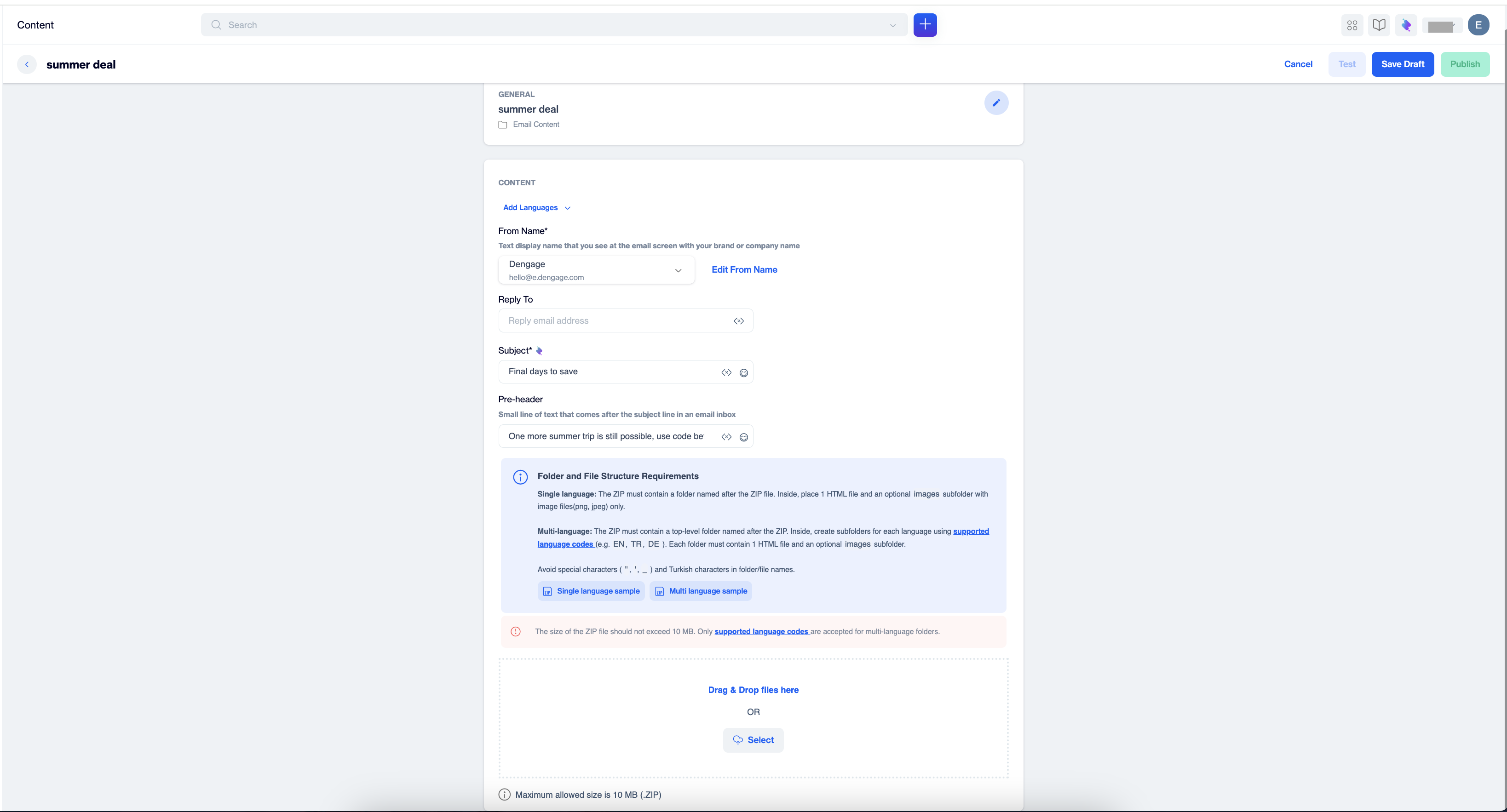
Step 2: Content Settings (Sender and Subject)
These fields define what recipients see in their inbox before they open the email:
| Field | What it does |
|---|---|
| From Name (required) | The sender identity displayed in the inbox. Choose one of your account's defined senders from the searchable dropdown, or click Edit From Name to manage your sender definitions. |
| Reply To | The address that receives replies. Supports customization tags via the <> icon. |
| Subject (required) | The subject line. Three helpers are available: the Zeki AI icon next to the field label for AI subject suggestions, the <> icon to insert personalization tags, and the emoji picker. |
| Pre-header | The short preview line shown after the subject in most inboxes. Also supports personalization tags and emojis. |
Step 3: Upload the ZIP
- Review the Folder and File Structure Requirements callout on the screen. It summarizes the rules above and hosts the two sample downloads.
- Drag & drop your ZIP onto the upload area, or click Select to browse for it. The uploader accepts .ZIP files up to 10 MB.
Once the file is uploaded, you can continue with saving, testing, and publishing from the same screen.
Personalize the Email
Click the <> icon on the Subject, Pre-header, or Reply To field to open the Customization Selector. Pick an attribute and it is inserted as a tag that is replaced with each recipient's own value at send time.
The Customization Selector organizes the available attributes in tabs:
| Tab | What you can insert |
|---|---|
| Contact Columns | Attributes from your contact table (name, email, city, custom columns and more) |
| Device Columns | Attributes of the contact's device |
| Dynamic Contents (Plain Text) | Reusable dynamic content snippets defined in your account |
| Columns From Segment | Columns coming from the target segment |
| Columns From Remote Segment | Columns coming from remote segments |
| Columns From Table | Columns from your custom data tables |
For personalization inside the email body itself, see Advanced Personalization in Email.
Add or Manage Language Versions
Uploading a multi-language ZIP is not the only way to localize. At the top of the Content step, the Add Languages menu offers two options:
- Copy from Content: start a new language version from an existing email content.
- Create Blank Email Content: add an empty language version and fill it in yourself.
The languages of each email content are visible in the Languages column of the email content list.
Language codes must be written in uppercase. The full list is in the Supported Language Codes reference.
Save, Test, and Publish
- Save Draft saves your work with the status Draft. Drafts are safe to keep editing and are not available to campaigns yet.
- Test opens the Preview & Test tools: a visual Preview of the email, a Spam Score check (scored 0 to 5) that flags words likely to trigger spam filters, and Send Test to deliver the email to a predefined testing list or to addresses you type in.
- Publish makes the content available for campaigns. Published contents show the Published status in the list, where you can start a campaign directly with Create Campaign.
Editing a published content creates a new draft version. Saving the draft alone does not change what campaigns send; you must Publish again for your changes to go live. If approval workflows are enabled in your account, the content shows Waiting Approval until it is approved.
Quick Reference
| Item | Value |
|---|---|
| Where to find it | Content > Email > + New > Upload File |
| Accepted file | .ZIP, max 10 MB |
| Contents of the ZIP | One folder named after the ZIP; 1 HTML file (+ optional images folder with .png/.jpeg) per folder |
| Multi-language | One uppercase language-code subfolder per language |
| Sample files | Downloadable from the upload screen (single- and multi-language) |
| Next steps | Save Draft, Test, and Publish from the same screen |
Tips for Better Results
- Start from the sample. Downloading the sample ZIP and replacing its HTML and images is the quickest way to a structure that passes validation.
- Use email-safe HTML. Email clients are far stricter than browsers: prefer inline CSS, table-based layouts, and a content width of around 600 px, and always set alt text on images.
- Optimize your images. Compressed .png and .jpeg files keep you comfortably under the 10 MB limit and load faster for recipients.
- Write the pre-header. It's optional, but inboxes will otherwise show the first text they find in your HTML, which is rarely what you want.
- Always run a test. Check the Preview, keep the Spam Score low, and send a test to a real inbox before publishing.
Troubleshooting & FAQ
My ZIP is rejected or the upload fails. What should I check?
In order: (1) the top-level folder has exactly the same name as the ZIP file, (2) there is exactly one HTML file per folder, (3) no quotation marks, apostrophes, underscores, or Turkish characters anywhere in folder or file names, (4) the ZIP is under 10 MB, and (5) in multi-language ZIPs, every language folder uses an uppercase supported language code.
My images don't show in the uploaded email.
Make sure the images are inside the images subfolder and are .png or .jpeg files; other formats are not accepted.
Can I add a language after the first upload?
Yes. Use the Add Languages menu on the Content step and either copy an existing content or create a blank version for the new language.
Where does my uploaded email go?
It is saved in the folder you selected in the General step and appears under Content > Marketing > Email, with the status Draft until you publish it.
Updated 2 months ago